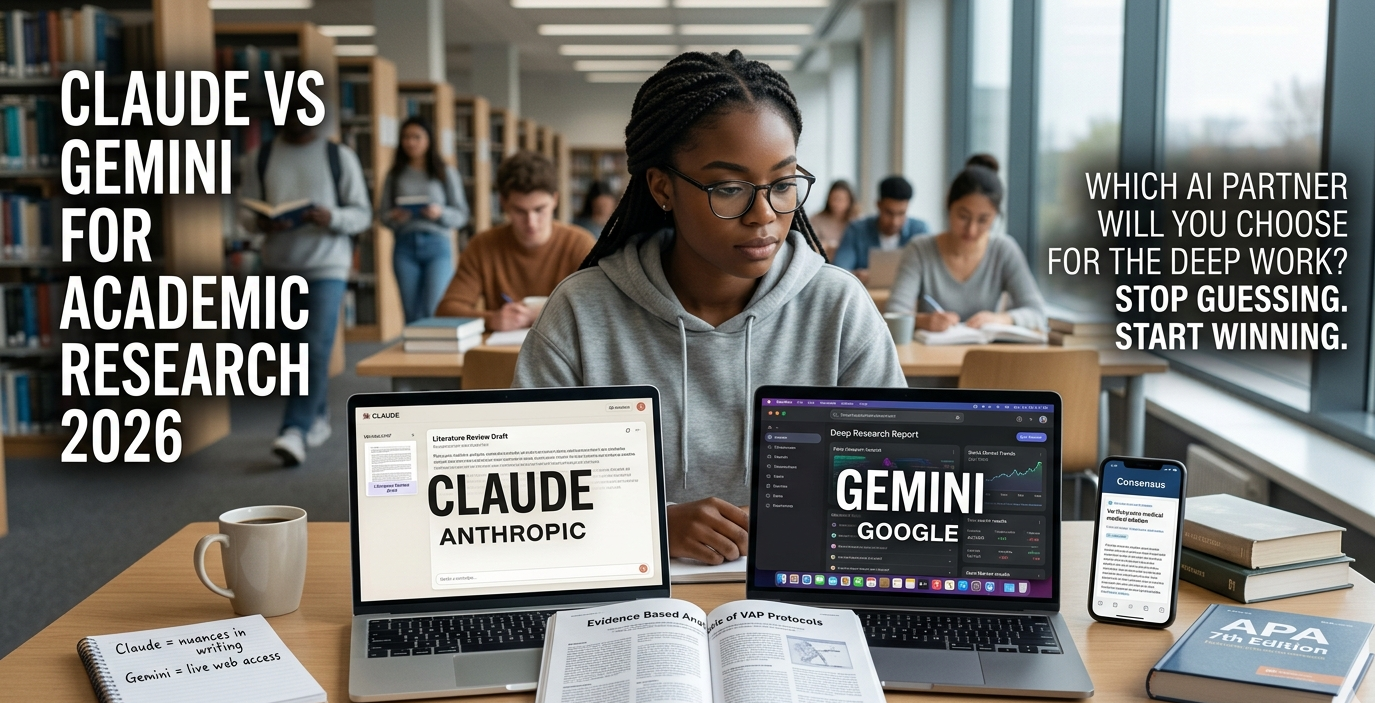
Claude vs Gemini for Academic Research 2026: The Ultimate Student Comparison
Claude vs Gemini for Academic Research 2026 The academic landscape in 2026 is no longer about who can spend the most hours in a library basement . It is about who can leverage the right digital partners to synthesize data, verify evidence, and draft compelling arguments. For students and researchers, the choice often boils down to two heavy hitters: Anthropic Claude and Google Gemini.
Both models have evolved significantly this year, but they serve very different purposes in the research workflow. If you are trying to decide which subscription is worth your investment, this deep dive will compare Claude vs Gemini for academic research to help you choose the right tool for your specific needs.

The Core Philosophies: Accuracy vs Scale
Before looking at specific features, it is important to understand the DNA of these two systems. Claude, developed by Anthropic, is built with a focus on Constitutional AI. This means it is designed to be helpful, honest, and harmless. In an academic context, this translates to “epistemic humility.” Claude is more likely to tell you when it is unsure about a fact or when a prompt is leading it toward a logical fallacy.
Gemini, on the other hand, is Google’s multimodal powerhouse. Its core strength is integration and scale. Because it is connected to the world’s largest search engine and your personal Google Workspace, it acts more like an omnipresent research assistant that can see across your emails, documents, and the live web simultaneously.
Literature Reviews and Long Document Analysis
One of the most grueling parts of research is the literature review. In 2026, both models offer massive context windows, but they handle large datasets differently.
Claude is widely considered the superior choice for deep reading. Its ability to maintain a consistent logical thread across a 200,000 token context window makes it perfect for uploading five or ten full length journal articles. When you ask Claude to find contradictions between those papers, it provides nuanced, human like analysis. It excels at spotting subtle differences in methodology that a less sophisticated model might miss.
Gemini 1.5 Pro and the newer 2.5 series offer an even larger context window, often reaching up to 2 million tokens. This is equivalent to thousands of pages of text or hours of video. If your research involves analyzing a massive archive of historical documents or an entire semester of recorded lectures, Gemini is the only tool that can “hold” all that information at once. However, while Gemini can find a needle in a haystack very quickly, it sometimes lacks the nuanced “literary” touch that Claude brings to the actual writing of the review.
Real Time Research and Data Grounding
This is where the two models diverge sharply. Gemini has a massive advantage when it comes to “grounding” or real time web access.
If your research topic involves current events, recent stock market trends, or the latest 2026 medical breakthroughs, Gemini is the clear winner. Because it is natively integrated with Google Search, it can fetch information that was published only minutes ago. It can provide links to the latest government reports or news articles, which is vital for fields like political science, economics, or public health.
Claude operates primarily on its training data and the files you upload. While it is incredibly smart, its “knowledge cutoff” means it cannot browse the live web for the absolute latest data unless you manually provide the text. For researchers working on “evergreen” topics or historical analysis, this is not a problem. But for those on the cutting edge of fast moving industries, Gemini’s live connection is a game changer.
Writing Quality and Academic Tone
When it comes to the actual drafting of a thesis or a research paper, the “personality” of the AI matters.
Claude is famous for its “human like” writing style. It avoids the repetitive, robotic patterns that often plague other AI models. When you ask Claude to write an abstract or an introduction, the result feels thoughtful and structured. It understands the nuances of academic tone—knowing when to be objective and when to acknowledge the limitations of a study. Many researchers prefer Claude for drafting because it requires fewer edits to sound professional.
Gemini’s writing tends to be more “bulleted” and informative. It is excellent at summarizing and creating outlines, but its prose can sometimes feel a bit more generic. However, Gemini has a “Deep Research” feature that is incredibly useful for the initial phases of writing. It can generate a multi page report by conducting hundreds of searches and synthesizing the findings into a structured draft, which you can then refine.
Multimodal Research: Beyond Text
In 2026, research isn’t just about reading text. It involves analyzing images, charts, videos, and audio recordings.
Gemini is the leader in multimodal research. You can show Gemini a video of a lab experiment and ask it to describe the chemical reaction taking place. You can upload a photo of a handwritten historical manuscript, and it can transcribe and translate it in seconds. This makes Gemini an essential tool for researchers in the sciences, arts, and history who work with non text media.
Claude has strong image analysis capabilities, but it currently lacks the native ability to process video or audio files directly. If your research is 100 percent text based, Claude is a fantastic partner. But if you need to analyze a screen recording of a user test or a podcast interview, Gemini is the more versatile choice.
Comparing the Student Workflow
To help you visualize which tool fits your day, let’s look at a typical research workflow for a student at Boxloaded.
If your goal is to organize your life and gather facts, Gemini is your best friend. It can find that one specific email from your professor about your thesis deadline, summarize the three Google Docs you have in your research folder, and give you the latest news on your topic. It is a “Management” tool.
If your goal is to do the “Deep Work” of thinking and writing, Claude is your best friend. Once you have your sources, you move them into a Claude Project. There, you can ask Claude to help you brainstorm your core argument, find logical flaws in your draft, and polish your academic prose. It is a “Creation” tool.
Pricing and Value for Students
Both services typically cost around 20 dollars per month for their “Pro” or “Advanced” tiers in 2026.
The value of Gemini Advanced is often higher for students because it usually includes 2TB of Google One storage and integrates directly into Google Docs and Gmail. If you are already “living” in the Google ecosystem, the productivity boost is massive.
The value of Claude Pro lies in the quality of the interactions. For many researchers, the time saved by not having to “fight” with a robotic sounding AI is worth the 20 dollars alone. Claude’s “Artifacts” UI also allows you to see code, charts, and documents side by side with your chat, which is a superior experience for long form writing.
Ethical Considerations and Hallucinations
No AI is perfect. In 2026, hallucinations (the AI making things up) are much less common than they were two years ago, but they still happen.
Claude’s “Constitutional” training makes it slightly more conservative. If it doesn’t know an answer, it is more likely to say “I don’t have enough information to answer that accurately.” This is a vital trait for academic work where accuracy is everything.
Gemini’s grounding helps reduce hallucinations by pulling from real websites, but you must still be careful. Sometimes the AI might summarize a “fake news” site or a low quality blog if it doesn’t filter the search results properly. Always use a tool like Consensus or Scite to verify the clinical or scientific facts that any AI gives you.
Final Verdict: Which One Should You Choose?
The “Claude vs Gemini” debate doesn’t have a single winner because it depends on your research stage.
Choose Google Gemini if:
-
You need real time information and live web searching.
-
You have a massive amount of data (like hours of video or thousands of pages) to analyze at once.
3. You are deeply embedded in the Google Workspace ecosystem.
Read more AI Tools for beginner 2026Choose Anthropic Claude if:
-
You want the highest quality “human like” academic writing.
-
You are doing a deep, nuanced literature review of a few specific papers.
-
You prefer an AI that is more cautious and less likely to exaggerate facts.
At Boxloaded, we often recommend a “hybrid” approach. Use Gemini to gather your data and perform the initial broad research. Then, take your best findings over to Claude to do the heavy lifting of synthesis, critical thinking, and final drafting. By using the strengths of both, you can ensure your research is not only fast but also of the highest academic quality.
About The Author