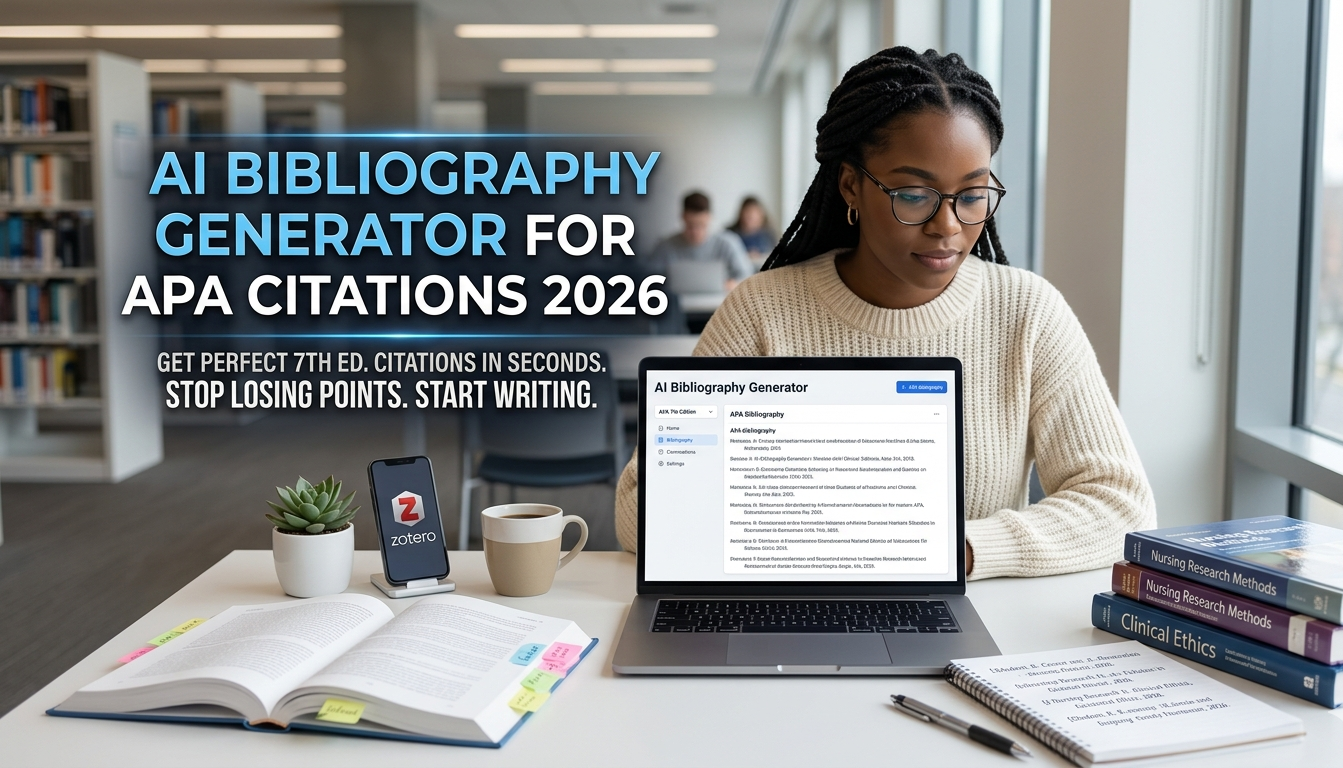
AI Bibliography Generator for APA Citations 2026: The Ultimate Guide for Students
The academic world in 2026 is moving faster than ever before. AI Bibliography Generator for APA Citations 2026 For students and researchers, the pressure to produce high quality, evidence based work is intense. One of the most time consuming yet vital parts of this process is the bibliography. Getting your APA citations wrong can lead to point deductions or even accusations of academic dishonesty. Fortunately, the rise of the AI Bibliography Generator for APA Citations 2026 has transformed this chore into a streamlined process.
In this guide, we will explore the best AI tools available this year to help you master APA 7th edition formatting. We will look at how these tools work, why they are better than traditional generators, and how to use them ethically to ensure your blog or paper meets the highest standards.
The Evolution of Citation Tools in 2026
Only a few years ago, citation generators were simple databases where you manually typed in a title and hoped for the best. They often produced broken links or missing author initials. Today, AI has changed the game. Modern tools use natural language processing to read a webpage or a PDF and automatically extract the correct metadata.
An AI bibliography generator in 2026 doesn’t just copy and paste. It understands the context. It can distinguish between a blog post, a peer reviewed journal article, and a government report. This level of intelligence is what makes the current crop of tools so essential for students who want to save time without sacrificing accuracy.
Top AI Bibliography Generators for APA Citations
If you are looking for a reliable tool to build your reference list, several platforms stand out this year. Each offers a unique way to handle the complexities of APA style.
MyBib: The 100 Percent Free Champion
MyBib remains a favorite among students because it is completely free and lacks the intrusive ads found on older platforms. In 2026, MyBib has integrated an AI feature called Fix All. This feature automatically scans your entire reference list to find missing DOIs or incorrectly formatted titles. It is an excellent choice for anyone who needs a clean, professional APA bibliography without a subscription fee.
Paperpal: The All In One Research Assistant
Paperpal has become a powerhouse in 2026 for those who want more than just a list of links. It is a comprehensive AI writing toolkit that helps you find and cite sources in over 10,000 styles. What makes Paperpal special is its ability to suggest relevant citations as you write. If you make a claim, the AI suggests peer reviewed papers that support your statement and formats the citation instantly.
QuillBot Citation Generator: Seamless Workflow Integration
QuillBot is famous for its paraphrasing abilities, but its citation tool is equally impressive. In 2026, it offers a highly effective APA generator that integrates directly into your writing workflow. It supports both 6th and 7th editions of APA, which is helpful if you are working with older institutional requirements. The interface is clean and allows for quick exports to Microsoft Word or Google Docs.
Scribbr: Precision and Accuracy
Scribbr has built a reputation for having the most accurate APA 7th edition logic. Their AI generator is regularly updated to reflect the latest nuances of academic formatting. In 2026, they have added a citation checker that compares your reference list against an massive database of real journals to ensure every volume and issue number is correct.
How AI Citation Tools Improve SEO for Your Blog
If you are running a blog like Boxloaded, using an AI bibliography generator is actually a secret weapon for SEO. Google rewards content that is well researched and properly attributed. When you include a clean, formatted reference list at the end of your articles, you are signaling to search engines that your content is trustworthy and follows E E A T principles.
Properly formatted citations with working links help reduce bounce rates because readers can verify your sources. Additionally, including keywords like APA 7th edition guide and evidence based research tools within your reference section can help your blog rank for academic search terms.
Ethical Use of AI in Citations
While these tools are powerful, they are not a replacement for human oversight. In 2026, academic integrity is a major topic. You should never assume an AI generated bibliography is 100 percent perfect. Always do a final check to ensure the author names are spelled correctly and the publication dates are accurate.
Another ethical consideration is citing the AI itself. If you use a model like Gemini or ChatGPT to help brainstorm your research, the APA 7th edition now has specific rules for this. You must credit the developer as the author and include the version of the model you used. This transparency is key to staying compliant with university policies.
Citing AI Models in APA 7th Edition
As of 2026, the standard format for citing a generative AI model is as follows:
Developer Name. (Year). Name of AI model (Version number) [Large language model]. URL.
For example, if you used a specific version of a model for research, your in text citation would look like (OpenAI, 2024) or (Google, 2026). Including these citations correctly shows that you are a modern, responsible researcher who understands the tools of the trade.
Managing Large Bibliographies with Zotero and Mendeley
For nursing students or those writing long dissertations, a simple web generator might not be enough. This is where reference managers like Zotero and Mendeley come in. In 2026, these tools have integrated AI plugins that can automatically summarize your saved PDFs and generate bibliographies in bulk.
Zotero is an open source tool that is highly customizable. Its browser connector can detect citation information as you browse the web, making it incredibly efficient for large projects. Mendeley, on the other hand, is excellent for collaborative research and allows you to share your reference libraries with classmates or colleagues.
Common Mistakes to Avoid with AI Generators
Even with the best technology, errors can happen. Here are a few things to watch out for in 2026:
One common mistake is relying on the AI to find the DOI. Sometimes a paper has a DOI but the AI fails to pull it from the webpage. Always double check your journal articles for this number, as APA style requires it.
Another issue is title capitalization. APA 7th edition uses sentence case for titles in the reference list. Some AI tools might keep the title in title case if that is how it appeared on the original website. You may need to manually lowercase certain words to stay compliant.
Lastly, watch out for the retrieved from date. For most sources, APA no longer requires a retrieval date unless the content is designed to change frequently, like a social media feed or a wiki page. Ensure your AI tool isn’t adding unnecessary dates to your book or journal citations.
The Future of Academic Referencing
As we look toward the rest of 2026 and beyond, we can expect AI bibliography generators to become even more integrated. We are already seeing tools that can look at a rough draft and tell you exactly where you forgot to include a citation. This proactive approach will help students avoid accidental plagiarism and focus more on their original ideas.
For blogs like Boxloaded, staying at the forefront of these tech trends is vital. By providing your readers with the best tools and guides, you establish yourself as a leader in the digital education space.
Final Thoughts on AI Citation Tools
Using an AI bibliography generator for APA citations in 2026 is a smart move for any student or content creator. These tools provide speed, accuracy, and a professional finish that was once very difficult to achieve manually. Whether you choose a free option like MyBib or a comprehensive suite like Paperpal, the key is to use the technology as a partner in your writing process.
By mastering these tools, you are not just finishing an assignment; you are building the skills needed for a tech driven professional world. Keep exploring, keep citing correctly, and keep pushing the boundaries of what you can achieve with the help of AI.
About The Author